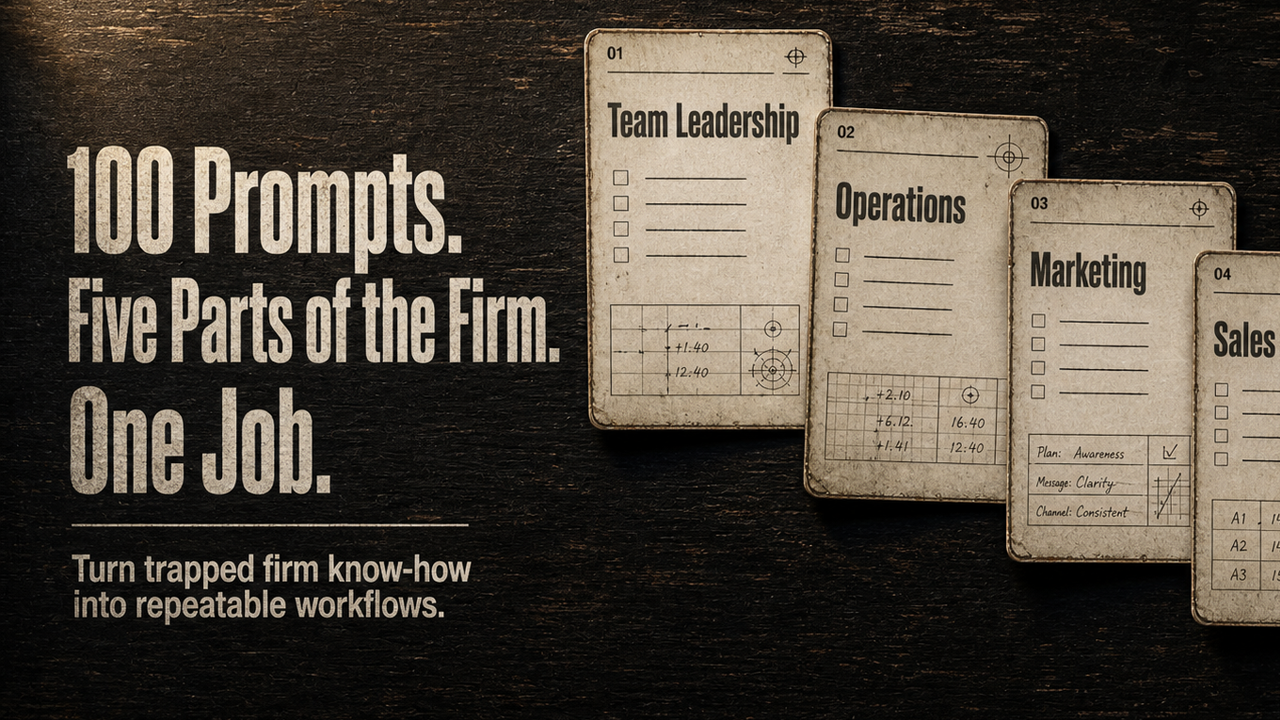
# 100 prompts. Five parts of the firm. One job: help accounting owners turn trapped know-how into repeatable workflows.
Most accounting firm owners do not need another generic prompt list.
They need a better way to get what is already trapped in their head into a form their team can actually use.
That is the real value of Intelligence Solved's guide, 100 Practical AI Prompts to Turn Firm Know-How Into Repeatable Workflows.
Not that it has 100 prompts.
It is that those prompts are organized around the five parts of the firm where owner knowledge keeps turning into bottlenecks:
- Team Leadership & Culture Building
- Systems & Operations Excellence
- Marketing & Brand Growth
- Sales & Revenue Generation
- Client Experience & Retention Systems
That structure matters.
Because the real problem inside a lot of firms is not “we have not tried AI yet.”
It is that too much useful judgment still lives in the owner's head.
The team needs it. The workflow depends on it. The output gets weaker the second that judgment is missing.
So the owner stays stuck doing invisible translation work.
Explaining the standard again. Fixing drafts again. Clarifying what “good” means again. Reviewing work that should have been more usable the first time.
That is why this guide is stronger than a random pile of prompts.
It is built around a more useful operating idea:
one prompt should help you build one usable asset, inside one real part of the firm, with judgment still in the loop.
That is also why the page asks the right question:
What can one prompt help you build by Friday?
That is a much better question than “How do I use AI more?”
It turns the conversation away from hype and toward implementation.
Not theory. Not inspiration. Not a vague promise that AI will transform everything.
A concrete workflow. A concrete output. A concrete use case your team can test.
The guide makes that practical in two ways.
First, it covers the actual operating surface of the firm.
You are not getting 100 random marketing prompts pretending to be a business system. You are getting prompts that map to leadership, operations, marketing, sales, and retention. That means the guide fits the real places where repeated work and owner-held judgment create drag.
Second, each prompt is built like a controlled assignment.
Instead of throwing a vague request into a blank chat box, the guide pushes toward four layers:
- context
- deliverable
- workflow
- controls
That is what makes the asset useful.
A prompt without that structure is usually just a cleaner way to ask for generic output.
A prompt with that structure has a much better chance of producing something your team can review, adapt, and actually use.
That distinction matters even more in accounting and bookkeeping.
The guide is not asking owners to hand professional judgment to a model. It is explicitly built around keeping judgment where it belongs.
That is the point of the line:
AI drafts. You decide.
So no, this is not a guide for replacing tax judgment, accounting treatment, compliance decisions, payroll interpretation, legal interpretation, cybersecurity judgment, or client-specific financial advice.
It is a guide for turning repeated know-how into stronger first drafts and clearer internal workflows.
That is a much more useful promise.
And it is why the “100 prompts” angle only works when the number is attached to the right structure.
100 prompts means coverage across the firm. Five parts of the firm means the guide maps to the real work. One job means every prompt is there to help turn trapped know-how into something repeatable.
That is what makes this worth reading.
If you want a practical place to start, download the guide and choose one recurring workflow that still depends too much on you.
Then ask a better question than “what can AI do?”
Ask:
What part of my firm's knowledge needs to become usable by someone else this week?
That is where better prompts become better workflows.
Download the guide: https://intelligencesolved.com/resources/100-practical-ai-prompts